Conversation Based
Students demonstrate the ability to speak/write/think about real world problems.
Introduction to Advocacy
It is imperative that teachers are developing student voice in every classroom. When taking this into account with advocacy, there is a multitude of ways to do this. From sentence stems for supporting English Language Learners and elementary students to writing assignments, there is flexibility in teaching students to communicate their needs, the needs of others, and real world problems.
Initially, I introduced this concept through conversational sentence stems in the first week of school. I discussed with students that advocating means to speak up for what you or others need. This practice was informal but done with the use of sentence stems posted that I encouraged students to utilize any time they had a need.
Initial Stages
Judson Robinson Elementary is a proud participant of Brighter Bites- a Houston based nonprofit that provides fresh free produce to families of our school community. The program additionally provides nutrition lessons focusing on real world problems for educators to roll out. During one of our lessons on sugars and sodium, the lesson became discussion based in which students voiced a problem they faced daily.
Students are provided breakfast and lunch
daily. For these meal options the only drinks
provided are milk and occasionally juice. Our
milk has a total of 12 g of sugar per serving. If
a student only has one milk a day, that is over
2,000 g of sugar annually that students ingest
without alternative options. After our Brighter
Bites lesson, my students and I concluded
that this practice is highly concerning for their
longer term health and all students of Houston
Independent School District. We determined
to develop an action plan that would use
student voice to advocate for change in their
daily nutrition intake. This systemic injustice negatively impacts the long-term wellness of the child and requires change.
Action Plan
Our plan began with determining who we needed to speak with and how we wanted to communicate our needs to these individuals. After conversation, the class determined to contact our state senators and our district superintendents via letters. These individuals are the ones who determine our day to day food and can develop policy to better suit students' needs.
A research team, consisting of four students, was able to utilize technology in class to gain these individual's contact information. The individuals planned to be contacted were Senator Ted Cruz, Senator John Cornyn, Superintendent Grenita Lathan, and Superintendent Geovanny Ponce.
Explicit Teaching
To prepare students to successfully write an advocacy letter to communicate our needs, I gave an explicit lesson to create vision and purpose and provide a checklist of what their letters should include. Students were provided a step by step process of letter writing and why individuals write letters together. This is not a state standard but I feel it has real-world importance. Daily I write e-mails and thank you notes that communicate appreciation and need to others in written form. This life-long skill builds relationships and develops documentation of voice.

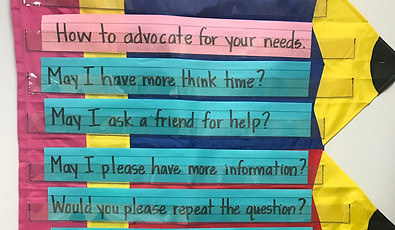
The topic of advocacy was first addressed for addressing a wide range of academic needs. For example, when students are called on and do not have an answer, there is a choice of sentence stems to support the scenario. As the year progressed and students began comfortably advocating, we shifted from this practice solely in academics to discussing issues or needs we had beyond misconceptions in the classroom.


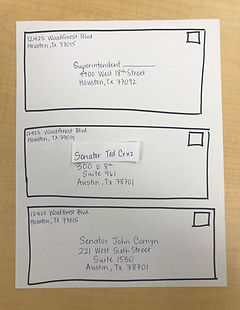
Researched addresses open to the public for our senators and superintendents and posted for student use during letter writing.

Brighter Bites Impact
Brighter Bites is a campus wide program that delivers fresh foods directly to students and their families and provides educators a nutritional curriculum to push out into the classroom. Monthly students engage with Catch Lessons defining integral components of wellness. Examples include sodium, sugar, and physical activity. The presentation above was provided by the program and defined sugar intake. I presented the information in class.
Based upon discussion that this presentation cultivated, students determined their conversation based advocacy project. They noted their lack of choice in drinks and applied their math problem solving skills to discover the exact amount of preventable sugar they were receiving daily. Students determined their sugar intake was impacting daily focus and is a long-term health concern. They decided to speak up for their need for water rather than milk on a daily basis. Public school nutrition provision not only impacts my kids but students across the state. By bringing awareness to this issue, many students will benefit should change occur.

Example of student notes documented in their interactive notebooks.

Teacher notes from explicit lesson.

Group Practice
To ensure letters were appropriate and impactful, during the lesson the whole class developed an example letter.
The letter encompassed our six step checklist.
1. Respectful greeting
2. Introduce yourself
3. State issue of advocacy
4. Suggest a solution
5. Thank the reader
6. Send off/farewell
Drafting
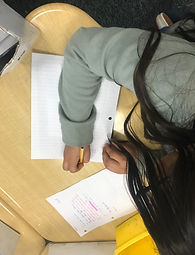
Students began their letter writing campaign by drafting letters in a comfortable setting prior to our lesson. I allowed students to draft prior to the explicit lesson to allow their most free thoughts to be expressed. Without the checklist, students shared openly. After the lesson the letters developed more purpose and organization with that same student voice.
During this phase, students were collaborating in table groups and sharing their writing with peers. This informal moment of conversation between table group members was pivotal to practicing the speaking component of student voice. If we had not had this time of engagement a larger portion of conversation would have been lost.


ELL student utilizes a greeting and introduction. In drafting, the student identifies the problem, but does not include solutions and a sign off. The missing components will be included in revisions.
Gifted and Talented student includes all six explicitly taught components but could benefit from organizational revision. Student will logically sequence information on final product.


Editing and Revising
Students additionally had class time to practice their advocacy of voice through written opportunities. This stage of letter writing was imperative to practice. It allowed students to implement lesson learning and correct mistakes. Editing and revising our letters post lesson and group practice proved to be incredibly helpful.


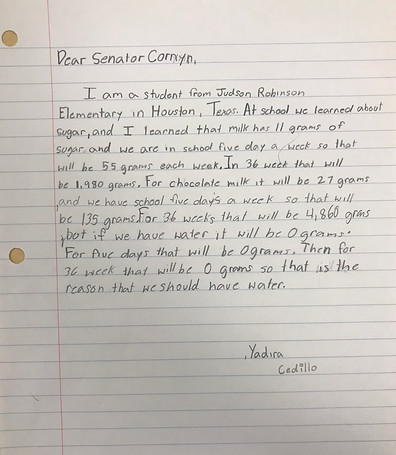

Student successfully follows all necessary steps on their draft. The strongest case is the student providing facts " 12 g times 7 days that equals 84 g of sugar for breakfast" to support why our lack of water is a problem. The student logically provides explanation of the alternative and its impact. This is a highly effective strategy when speaking to a need.
Student successfully includes a variety of persuasive techniques, most notably in the introduction of self and the problem. Student appropriately addresses Senator Cornyn with capitalization and punctuation. Editing of spelling and capitalization beyond the introduction can take their persuasion to the next level.
Student provides sound argument to support problem (step three of letter writing process). She logically and respectfully introduces herself and provides a respectful send off.
This writing sample made me laugh because the student directly addressed the superintendent by their last name. In the final draft the student will use proper titles.
Student drafts basic format of the steps and clearly states our issue of concern, and it's impact "I get tired really fast". Student will adjust closing in their final draft.
Student uses comparative data to further drive home the need for water as a drinking option. Student includes proper greeting and respectful dialogue.
Final Product
Through written practice, students had the experience of thinking about real world issues that mattered to them. Based on survey data, 83% of students had ascribed their nutritional wellness as highly important. By developing an ongoing project, students delved deeply into learning about what has significance to them and their day to day. Their efforts in this project will not only impact them but also students across our district. Should those in power we reached out to respond and develop change, thousands of students might be effected.
Final Products to Superintendent Lathan And Superintendent Ponce

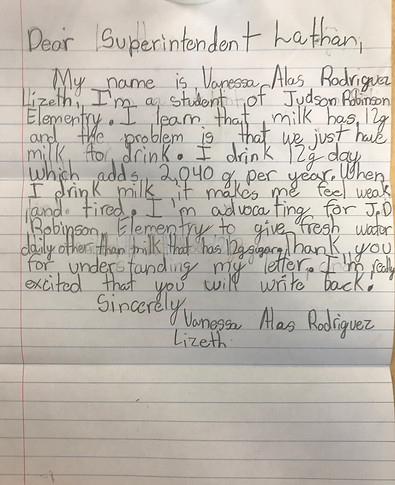
Student meeting 100% of checklist for writing an advocacy letter. Student cites 11 g of sugar directly taken from Catch Lesson provided by Brighter Bites curriculum programming.

Student providing information of our action plan and letter recipients. Apparent inclusion of gratitude for listening to his perspective on the issue.
Student revised letter to address appropriate title from drafting stage. The introduction is more respectful and will allow the student to properly address others in the future.

Student fostering strong communication skills through appropriate introductions and mindful conclusion addressing our district superintendent.

ELL student on grade level for writing content. Student closely aligned to teacher's modeled sample and will be pushed to include personal thinking before mailing.

Student performing below grade level meets all requirements of letter writing by working alongside modeling of teacher. Direct citations are noted in defining purpose and personal thinking.
Final Products to Senator Ted Cruz and Senator John Cornyn


Student providing information of our action plan and additional letter recipients. This allows student voice to go beyond our six steps and include additional important pieces of information.
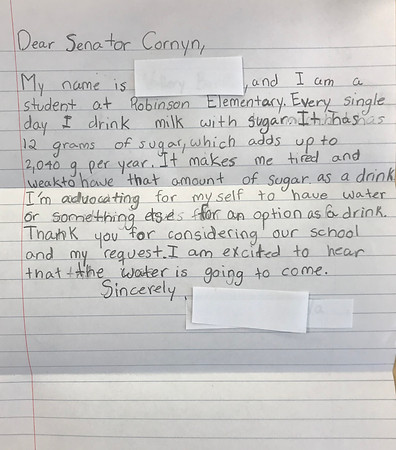
Student makes compelling argument with facts and figures adhering to step three's purpose and citing our in class investigation of sugar. This logically lays out the impact of their school provided nutrition.

Student citing the title of an advocacy letter given during the lesson, by acknowledging the purpose of the letter is to speak up for their friends wellness,
Student with IEP supported through accommodation of transcribing and sentence stems. Student cites exact group work when stating their introduction.

Gifted and Talented Student product expanding on daily impact of solely receiving milk on their body and performance at school and in sports.

ELL student finding success in their letter writing through the inclusion on facts from our Catch Lesson and the impact not only on our community but all students in the district.
Mailing Our Communication
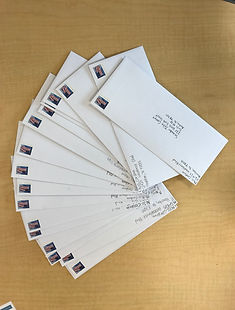
Throughout this advocacy project, students learned the entire process of communicating needs. Our final step was learning to address an envelope and sending the mail out. I gave an explicit lesson and posted visuals around the room for how to accurately address a letter. Over half my class had never addressed an envelope before this experience. Due to mail being an unused mode of communication for most of my students, this gave me further insight to the ways my students do communicate. The emphasis is put on social media and text messaging for instant access. From this learning opportunity, their reliance on technology can now be balanced with more traditional communication from this experience.